Friday, January 4, 2013

Atoms and Smaller: Cosmos

Cosmos
Author: Carl Sagan 

Another interesting clip from the classic book from Carl Sagan: 

Democritus invented the word atom, Greek for “unable to be cut.” Atoms were the ultimate particles, forever frustrating our attempts to break them into smaller pieces. Everything, he said, is a collection of atoms, intricately assembled. Even we. “Nothing exists,” he said, “but atoms and the void.”

Marinate on that for a second.

Wednesday, January 2, 2013

Religious Tolerance: The Economist

The Economist
November 24th, 2012

These quotes come from a great article in the Economist about Islam and religious tolerance. I think they did a great job highlighting the fact that followers of Islam are not homogeneous, rather there are various sects all over the world existing within a diverse set of cultures. It also gives me some perspective on the controversial approach of mixing church and state.


Indonesia, for example, demands that people declare themselves as one of six religions; atheism and agnosticism do not count. Egypt’s draft constitution makes room for only three faiths: Christianity, Judaism and Islam.

It's always nice to know a quote from a religious text if you are conversing(or debating) with people about religion. I thought this quote is particularly pertinent:

The Koran’s notably tolerant Sura 109 includes words such as “For you is your religion, and for me is my religion.”

Legal tricks: The World According to Monsanto


by Marie Monique-Robin

A great read, The World According to Monsanto provides a startling look at the corporate titan. While discussing the legal problems of Monsanto in regards to their improper PCB disposal in Alabama. It brought up an interesting point about corporations, individual responsibility and the loopholes in our legal system. 

The status of corporations as “persons” in United States law generally shelters company officials from individual liability. “In the American legal system,” said Cook, “it is very rare for executives or managers of companies to be found criminally liable. On the other hand, companies can be sued in civil court, and they are made to pay. But in fact, the damages they pay decades later are only a fraction of their profits. So it pays to keep secrets. I wonder what secrets Monsanto is keeping now. You can never trust a big company like Monsanto to tell us the truth about a product or a pollution problem. Never.”

New word- hyponym: Dictionary

Occasionally I'll post an interesting word that I've learned while reading. I don't claim to have the largest vocabulary so I apologize if these are too low brow for you.


hy·po·nym  n. a word of more specific meaning than a general or superordinate term applicable to it. For example, spoon is a hyponym of cutlery. Contrasted with HYPERNYM.

Thursday, December 20, 2012

Corn: The Omnivores Dilemma


Author: Michael Pollan

I read this book a few years ago but recently discovered Michael Pollan has been making a lot of noise in the world of food and decided to re-read this book. My opinion regarding the politics of the agriculture industry and US food culture cannot possibly fit into one post on this blog so I’ll focus on this quote, which examines the role of the agriculture industry in our complex economic system.

"The free market has never worked in agriculture and it never will. The economics of a family farm are very different than a firm's: When prices fall, the firm can lay off people, idle factories, and make fewer widgets. Eventually the market finds a new balance between supply and demand. But the demand for food isn't elastic; people don't eat more just because food is cheap. And laying off farmers doesn't help to reduce supply. You can fire me, but you can't fire my land, because some other farmer who needs more cash flow or thinks he's more efficient than I am will come in and farm it. Even if I go out of business this land will keep producing corn."

The quote specifically raises questions about the US’s increasing dependence on corn and the subsequent subsidies and incentives to keep corn booming. As the age old saying goes; you are what you eat. And I think it’s wise to look at what we eat and where it comes from.

Read the ingredients on the label of any processed food and, provided you know the chemical names it travels under, corn is what you will find. For modified or unmodified starch, for glucose syrup and maltodextrin, for crystalline fructose and ascorbic acid, for lecithin and dextrose, lactic acid and lysine, for maltose and HFCS, for MSG and polyols, for the caramel color and xanthan gum, read: corn.

Wednesday, December 19, 2012

Growing digital space and data centers: The Economist


The Economist
October 27th, 2012

A recent article in the Economist encouraged me to clip this sound byte:

The amount of data being generated is growing at an eye-popping pace: IBM estimates that 2.5 quintillion bytes are being created every day and that 90% of the world’s stock of data is less than two years old.

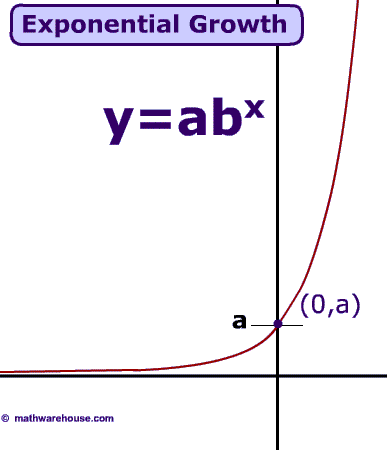
The article focuses on the implicit growth of data storage as the internet grows. The fact that 90% of the world's stock of data is less than two years old is truly mindblowing. I hesitate to state that it shows the exponential of growth of the internet because that would mean we're already reached a crescendo but perhaps growth will slow and stabilize. 

I think it's easy to think about the internet as not actually existing in physical space, but every bit of data that we save on the "cloud" of the internet is stored somewhere...including this blog. 

Afterlife: The World As I See It


Author: Albert Einstein

Albert Einstein is known for his profound scientific theories, though his theories tend to require a high level of knowledge pertaining to physics and mathematics and remain inaccessible to the majority of people. In fact, I recently tried reading a copy of his book “Relativity: The Special and General Theory” and found it nearly impossible for me to digest so quickly switched over to “The World As I See It”, a collection of essays and writings encompassing a variety of subjects. I was surprised at the variety of subjects in the book and it’s nice to see writings outside of disciplines regularly associated with Einstein.

Religion can be a touchy subject so I’ll let this quote speak for itself:

I cannot conceive of a God who rewards and punishes his creatures, or has a will of the type of which we are conscious in ourselves. An individual who should survive his physical death is also beyond my comprehension, nor do I wish it otherwise; such notions are for the fears or absurd egoism of feeble souls. Enough for me the mystery of the eternity of life, and the inkling of the marvellous structure of reality, together with the single-hearted endeavour to comprehend a portion, be it never so tiny, of the reason that manifests itself in nature.